
The Maharashtra 3-Jyotirlinga Circuit, Walked Slowly
Trimbakeshwar, Bhimashankar and Grishneshwar in one unhurried circuit from Mumbai or Pune — the route, the darshan, and when to go in Shravan
DESTINATION GUIDE
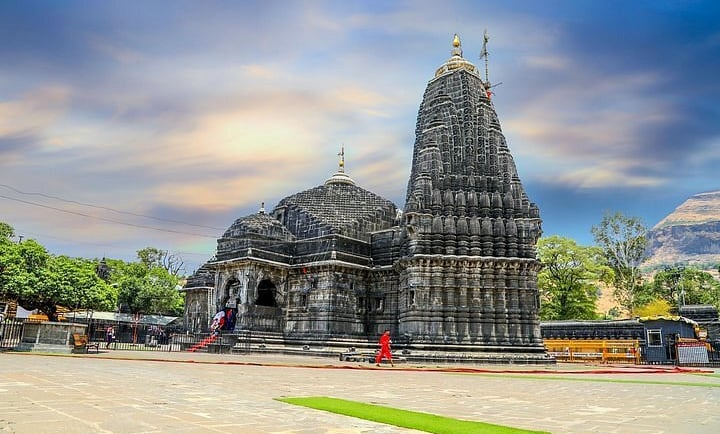
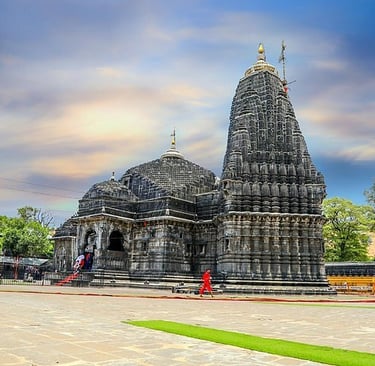
Three of the twelve Jyotirlingas sit within a day's drive of each other in Maharashtra, and the circuit that joins them — Trimbakeshwar near Nashik, Bhimashankar in the Sahyadri forest, Grishneshwar beside the Ellora caves — is one of the most doable pilgrimages in the country. But the travellers who get the most from it are the ones who don't rush the darshan for the drive.
This is the circuit at a human pace — what each temple is, how the route joins up, and how to time it if you're coming in Shravan.
The three shrines, and why each matters
Trimbakeshwar, at the foot of the Brahmagiri hills near Nashik, is the only Jyotirlinga with a three-faced lingam — Brahma, Vishnu and Shiva together — and it stands at the source of the Godavari, the “Dakshin Ganga.” Bhimashankar sits deep in the Sahyadris inside a wildlife sanctuary, green and misted for half the year, where the temple and the forest are inseparable. Grishneshwar, the smallest of the twelve, stands in warm red basalt right beside the Ellora caves — which means your pilgrimage ends a short walk from one of the great wonders of Indian rock-cut art.
How the route joins up
From Mumbai the natural loop runs Bhimashankar, then Trimbakeshwar and Nashik, then Grishneshwar, breaking naturally near Nashik or Shirdi and again near Aurangabad; from Pune, Bhimashankar comes first and easiest at around 110 km. The full circuit is roughly 900 km of good Western-Ghats road. Most journeys fold in Shirdi's Sai Baba temple and Ellora, so the trip becomes pilgrimage, heritage and a fine stretch of driving all at once.
Going in Shravan — read this first
Shravan (roughly July–August) is the most spiritually charged time to make this trip and, for the same reason, the most crowded. Trimbakeshwar and Bhimashankar see enormous footfall on Shravan Mondays and through the Kanwar period, and route diversions are common. If you're going then, the two things that save the trip are booking stays well ahead and starting each darshan early — pre-dawn, at the Kakad Aarti, before the queues build. It is also the greenest the Sahyadris ever get, so the discomfort buys you something.
Who the circuit suits
This is a trip that genuinely works for everyone — solo pilgrims, families, senior citizens — because the distances are gentle. Travelling as a group takes the two irritations out of it: the driving on unfamiliar temple-town roads, and the darshan logistics at each shrine. You arrive, you're guided in, and you keep your attention on why you came.
The circuit is Trimbakeshwar, Bhimashankar and Grishneshwar — three shrines, one unhurried loop from Mumbai or Pune, with the darshan timed to miss the worst of the queues. Make the yatra with GoRaahi.